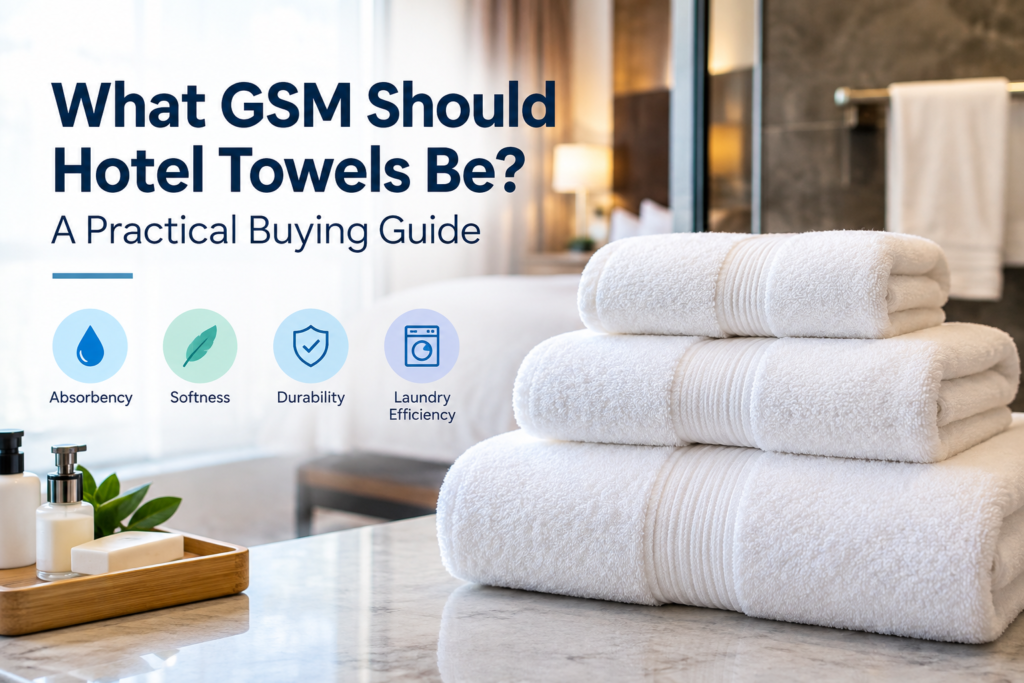
What GSM Should Hotel Towels Be? A Practical Buying Guide
What GSM should hotel towels be? For many hotel bath-towel programs, around 500–600 GSM is a practical starting range, but there is no single GSM that is right for every hotel. The best specification depends on the desired guest experience, towel size, cotton and yarn quality, construction, laundry capacity, drying conditions, and how frequently the towels are turned over. A heavier towel can feel more substantial and absorbent, but it can also take longer to dry and add weight to commercial laundry loads.
What Does GSM Mean in Hotel Towels?
GSM stands for grams per square metre. It describes the weight of the fabric per square metre.
In simple terms, GSM helps a hotel buyer understand how substantial a towel is. A higher GSM generally means more material is present within the same area of fabric, while a lower GSM generally produces a lighter towel.
However, GSM is not a quality grade.
A 600 GSM towel is not automatically better than a well-made 500 GSM towel. Fiber quality, yarn construction, terry-loop design, finishing, stitching, dimensions, and laundering can all affect how a towel feels and performs.
CottonWorks, a textile-industry resource from Cotton Incorporated, similarly explains that towel selection should consider fiber, yarn quality, construction, finishing, and GSM rather than relying on one specification alone.
That distinction is particularly important for hotels because towels must perform repeatedly, not just feel impressive when they are first unpacked.
What GSM Should Hotel Towels Be?
For many hospitality operations, 500–600 GSM is a useful starting range for bath towels when the goal is to balance comfort, absorbency, substantial hand-feel, and manageable drying requirements.
A practical way to think about towel GSM is:
| Approximate GSM | General characteristics | Potential hospitality use |
|---|---|---|
| 300–400 GSM | Lightweight and relatively quick drying | High-turnover, gym or selected pool applications |
| 400–500 GSM | Lighter commercial weight with reasonable absorbency | Economy and efficiency-focused hotel programs |
| 500–600 GSM | Balanced weight, comfort and absorbency | Many standard to upscale hotel bathrooms |
| 600–700 GSM | Heavier and more plush | Luxury rooms, suites, resorts and spa applications |
| 700+ GSM | Very heavy and substantial | Select premium or spa applications where laundry capacity allows |
These are planning ranges, not mandatory hotel standards. Current hospitality sourcing guidance shows different ranges depending on the supplier and intended use, which reinforces the importance of testing the actual towel rather than selecting a GSM number in isolation.
Is 500 GSM Good for Hotel Towels?
Yes. 500 GSM can be a very practical choice for hotel towels, particularly where a hotel wants a balance between guest comfort and operational efficiency.
Compared with a very lightweight towel, a 500 GSM towel can provide a more substantial feel and good absorbency without reaching the weight of very heavy luxury towels.
It can therefore make sense for properties that need:
- Regular commercial laundering
- Reasonable drying times
- Comfortable guest-room towels
- Good absorbency
- Controlled towel weight
- Efficient housekeeping operations
The exact result still depends on construction. Two towels with the same 500 GSM specification can feel and perform differently if their cotton, yarn, pile, finishing, dimensions, or manufacturing quality differ.
Is 600 GSM Good for Hotel Towels?
600 GSM can be an appropriate choice when a hotel wants a heavier, plusher towel and has sufficient laundry capacity.
The additional fabric weight can contribute to a more substantial hand-feel and, depending on construction and fiber, greater absorbency. However, the extra weight also means more material has to be washed and dried.
For a hotel with efficient commercial laundry equipment, suitable drying capacity, and a premium guest-room positioning, 600 GSM may be a sensible specification.
For a property with tight drying capacity or very rapid towel turnover, a lighter towel may be operationally easier.
The right decision is therefore not simply:
“Higher GSM = better.”
It is:
“Which GSM gives us the guest experience we want without creating unnecessary operational problems?”
Does Higher GSM Mean Better Hotel Towels?
No.
Higher GSM indicates greater fabric weight per square metre, but it does not independently establish overall towel quality.
A hotel’s towel specification should also consider:
1. Fiber quality
Cotton is widely used for towels because of its absorbency and suitability for toweling. CottonWorks notes that cotton fiber characteristics and quality can affect the feel and performance of towels.
2. Yarn construction
Combed and ring-spun yarns are examples of construction choices that can influence the feel and performance of a towel.
3. Terry construction
The loops that form the terry surface play an important role in how the towel feels and absorbs water.
4. Finishing
Finishing treatments can change the initial hand-feel and appearance of a towel. Buyers should consider how the towel performs after laundering, not just how it feels before use.
5. Stitching and hems
Hotels wash towels repeatedly, so edge construction and stitching deserve attention when evaluating commercial towels.
6. Dimensions
GSM does not tell you the actual weight of the finished towel.
A large 500 GSM bath sheet contains more fabric than a smaller 500 GSM bath towel. Therefore, two towels with the same GSM can have very different piece weights.
How Does GSM Affect Towel Absorbency?
GSM and absorbency are related, but they are not the same measurement.
A higher-GSM terry towel generally contains more material per unit area and may provide a fuller, more absorbent structure. But absorbency depends on much more than fabric weight.
Fiber properties, yarn construction, terry-loop structure and finishing can all influence how quickly and effectively a towel takes up water.
CottonWorks defines textile absorbency as the ability of a fabric to take in and hold liquid within the fiber, yarn or spaces in its structure. It also references standardized absorbency testing for textile materials.
For hotel procurement, this means you should not approve a towel simply because its GSM number looks impressive.
Test the actual towel.
How Does GSM Affect Hotel Laundry?
One of the biggest practical considerations is laundry.
A heavier towel contains more fabric per square metre. At the same dimensions, a higher-GSM towel will generally have a greater piece weight.
That can affect:
- Washer load weight
- Dryer load weight
- Drying time
- Laundry throughput
- Energy consumption
- Handling during housekeeping
- Storage and transportation weight
This is why a 650 GSM towel may not be the right choice for every hotel.
A property with limited dryer capacity may benefit more from a well-constructed mid-weight towel than from simply choosing the heaviest specification available.
A simple procurement principle
Choose the towel according to the entire operating system, not just the guest-room presentation.
The towel has to work for the guest, housekeeping team and laundry operation simultaneously.
What GSM Is Best for Luxury Hotels?
Luxury hotels often consider higher GSM towels, such as approximately 550–700 GSM, when a plush and substantial guest experience is important.
However, there is no universal luxury-hotel GSM requirement.
A luxury property might select a 600 GSM towel for guest bathrooms while choosing a different specification for pool areas, gyms or other high-turnover applications.
The decision should consider:
- Desired hand-feel
- Absorbency
- Towel dimensions
- Cotton and yarn quality
- Laundry equipment
- Drying capacity
- Climate and humidity
- Replacement expectations
- Storage capacity
- Procurement budget
A premium hotel should therefore avoid treating GSM as a shortcut for “luxury.”
What GSM Is Best for High-Turnover Hotels?
Hotels with rapid room turnover may place greater emphasis on drying performance and laundry efficiency.
In those situations, a lighter or mid-weight towel can sometimes be more practical than a very heavy towel.
The appropriate range depends on the hotel’s specific operation, but approximately 400–550 GSM can be considered when efficiency is an important part of the specification.
This does not mean that every high-turnover hotel should use 400 or 500 GSM. It means the buyer should evaluate towel weight together with actual laundry performance.
Should Hotel Bath Towels and Pool Towels Have the Same GSM?
Not necessarily.
Different hotel areas have different requirements.
A guest-room bath towel may prioritize:
- Softness
- Absorbency
- Comfort
- Premium presentation
A pool towel may place greater emphasis on:
- Practical handling
- Drying speed
- Frequent turnover
- Outdoor use
- Size and weight
Likewise, spa towels may be selected for a particularly plush feel.
This is why hotels should create use-specific towel specifications rather than automatically purchasing one GSM for every towel in the property.
What Other Hotel Towel Specifications Should You Check?
GSM is only one line on a hotel towel specification sheet. Fiber quality, yarn construction, terry-loop design, finishing, and GSM can all influence towel performance. For additional textile guidance, see the CottonWorks towel buyer’s guide.
Before placing a commercial order, consider the following.
Fiber content
Confirm whether the towel is 100% cotton or a blend and identify the relevant fiber characteristics.
Yarn type
Ask about the yarn construction and whether it is appropriate for the expected use and laundering conditions.
Towel size
Specify the finished dimensions rather than discussing GSM alone.
Terry construction
Review the pile and loop construction because it contributes to absorbency and hand-feel.
Edge and hem construction
Check whether the hems and edges are suitable for repeated commercial laundering.
Color and dye performance
For colored towels, ask about colorfastness and the planned laundry process.
Absorbency
Where possible, assess the actual towel using a consistent testing or sample-approval process.
Laundry performance
Wash and dry a representative sample using the hotel’s intended process before approving a large order.
Shrinkage
Confirm expected dimensional change after laundering, particularly for towels used repeatedly in commercial operations.
Piece weight
Do not confuse GSM with the finished weight of the towel. Actual dimensions matter.
How Should a Hotel Choose the Right GSM?
A simple procurement process can prevent many problems.
Step 1: Define the use
Decide whether the towel is for guest bathrooms, suites, spa facilities, pool areas, gyms or another application.
Step 2: Define the guest experience
Decide whether the priority is lightweight practicality, balanced comfort or a particularly plush feel.
Step 3: Review the laundry operation
Consider washer capacity, dryer capacity, turnaround time, drying conditions and expected daily volume.
Step 4: Compare the complete specification
Compare GSM together with fiber, yarn, construction, dimensions, finishing and stitching.
Step 5: Request samples
Never approve a commercial towel solely from a specification sheet.
Step 6: Test the sample
Wash and dry the sample using the intended commercial process. Check its feel, absorbency, appearance, dimensions and drying behavior.
Step 7: Confirm the specification
Once the sample is approved, document the GSM, dimensions, fiber content, construction, color and other agreed specifications.
For hospitality buyers evaluating a broader bathroom linen program, the Atlas & Indus Linen bathroom collection provides a natural next step after understanding towel specifications.
A Practical Hotel Towel GSM Checklist
Before choosing a towel, ask:
- What is the intended use?
- What GSM is being quoted?
- What are the finished towel dimensions?
- What is the actual piece weight?
- What is the fiber content?
- What yarn construction is used?
- What is the terry construction?
- How are the hems finished?
- How does the towel perform after washing?
- How quickly does it dry?
- Can the hotel’s laundry handle the weight?
- Does the towel provide the desired guest experience?
- Has a representative sample been tested?
This approach is more reliable than choosing a towel because it has the highest GSM.
Frequently Asked Questions
What GSM should hotel towels be?
There is no universal hotel GSM. Around 500–600 GSM is a practical starting range for many hotel bath-towel programs, while lighter or heavier specifications may be appropriate depending on use, guest expectations and laundry capacity.
Is 500 GSM good enough for a hotel?
Yes. A well-constructed 500 GSM towel can provide a useful balance of comfort, absorbency and manageable laundry weight. The quality of the cotton, yarn, construction and finishing also matters.
Is 600 GSM too heavy for hotel towels?
Not necessarily. 600 GSM can work well for premium hospitality applications, but the hotel should confirm that its laundry and drying operation can handle the additional weight and drying requirements.
Is higher GSM always better?
No. Higher GSM means more fabric weight per square metre, not automatically higher overall quality. Fiber, yarn, construction, finishing, dimensions and laundering all influence performance.
What GSM is best for luxury hotel towels?
Luxury hotels may choose approximately 550–700 GSM when they want a heavier, plush towel, but there is no universal luxury-hotel requirement. The final choice should be tested against the hotel’s operational requirements.
Does higher GSM make towels more absorbent?
Higher GSM can contribute to a more substantial and potentially more absorbent towel, but GSM alone does not determine absorbency. Fiber, yarn, terry construction and finishing also matter.
Do higher GSM towels take longer to dry?
They can. Heavier towels generally contain more material and may require more drying time, although the actual drying performance depends on towel construction, laundry equipment and drying conditions.
What is more important: GSM or cotton quality?
Neither should be considered in isolation. GSM describes fabric weight, while fiber and construction affect other aspects of towel performance. A hotel should evaluate the complete specification and test samples under its actual operating conditions.
Final Takeaway
If you are asking what GSM hotel towels should be, start by considering 500–600 GSM for many standard bath-towel programs, then adjust the specification according to the hotel’s positioning, towel use and laundry operation.
For a more efficiency-focused program, a lighter towel may make sense. For premium guest rooms, suites or spa environments, a heavier towel may be appropriate.
The most important point is that GSM should be treated as one specification—not the definition of towel quality.
A successful hotel towel program balances guest comfort, absorbency, durability, presentation, laundry efficiency and total operating requirements. Requesting samples and testing them through the hotel’s real laundering process is one of the most useful steps a hospitality buyer can take before committing to a bulk order.