
Do Hotels Wash Comforters? What Travelers Should Know
If you have ever wondered, do hotels wash comforters after every guest, you are not alone. The answer is: sometimes, but not necessarily after every stay. Hotel bedding practices vary by property, bedding design, housekeeping procedures, laundry capacity, manufacturer care instructions, and applicable local regulations.
A hotel may use a traditional comforter, a duvet insert with a removable cover, or a layered bedding system. These arrangements can have very different cleaning schedules.
The most important distinction is between the outer bedding layer that guests directly contact and the bulky insert or comforter underneath it. Many hotels can launder removable covers and sheets more frequently than the entire filled comforter or duvet insert.
There is also no single worldwide rule stating that every hotel must wash every comforter after every checkout. Regulations can vary by jurisdiction, while individual hotels establish their own housekeeping and laundry procedures.
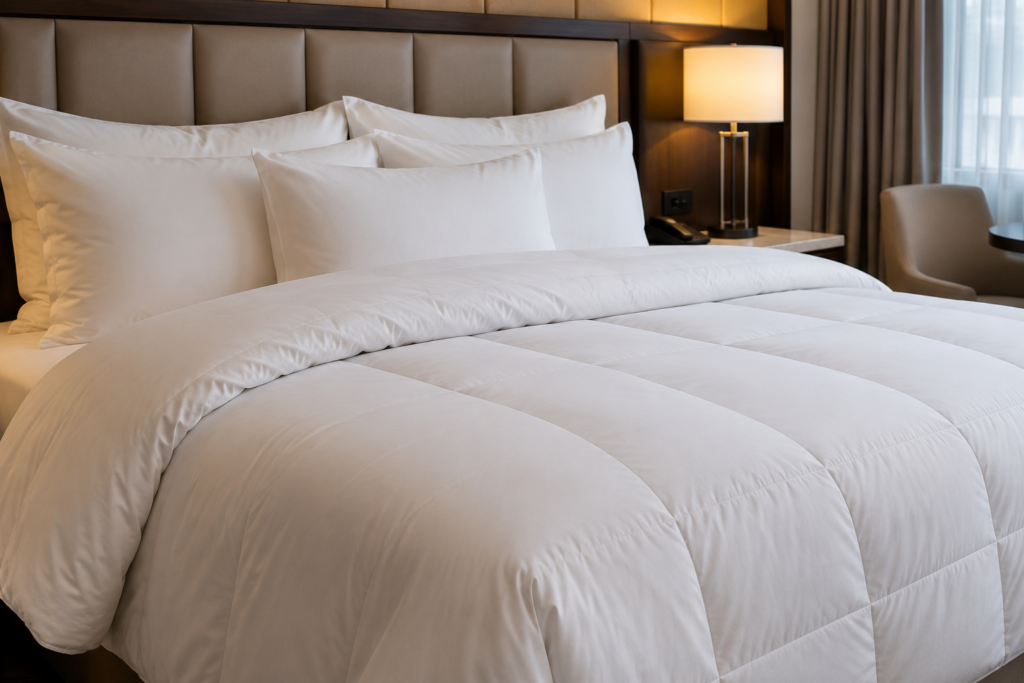
Do Hotels Wash Comforters?
Yes, hotels wash comforters, but the frequency varies.
Some hotels may launder the entire comforter or duvet insert between guests. Others use a removable duvet cover or layered-sheet system that allows the exposed bedding to be removed and laundered while the heavier insert is cleaned according to a separate schedule.
This distinction matters because the word “comforter” is sometimes used loosely to describe several different components of a hotel bed.
For example, a hotel bed may contain:
- A fitted sheet
- A flat sheet
- A blanket or cover
- A duvet cover
- A duvet insert
- A comforter
- A decorative bedspread
Not every property uses the same combination.
Current hospitality guidance and industry sources support the idea that hotel bedding practices are not identical across all properties. The American Hotel & Lodging Association’s hospitality-law database also demonstrates that bedding requirements can vary by jurisdiction. For example, some state regulations specifically address clean bedding and the handling or laundering of hotel linens.
Do Hotels Wash Comforters After Every Guest?
Not necessarily.
This is one of the most important answers for travelers. Hotels do not follow one universal schedule for washing every comforter after every checkout.
A property may:
- Wash the complete comforter after each guest.
- Wash a removable duvet cover between guests while cleaning the insert separately.
- Use clean sheets as barriers around a duvet or blanket.
- Remove and launder the comforter when it is visibly soiled.
- Follow a scheduled deep-cleaning or linen-rotation procedure.
- Follow the manufacturer’s specific cleaning instructions.
The exact procedure depends on the hotel’s bedding system and housekeeping policy.
Recent competitor research also shows this variation. Beds & Spreads explains that some properties use removable duvet covers while cleaning inserts less frequently, while DOWNLITE similarly notes that comforter-cleaning practices vary by hotel and property type.
Therefore, it would be inaccurate to claim that all hotels wash comforters after every guest or that no hotels wash comforters between guests.
Both practices can exist.
What Is the Difference Between a Comforter and a Duvet?
Understanding the terminology makes hotel laundry practices much easier to understand.
A comforter is generally a filled, quilted bedding piece designed to be used as one complete item.
A duvet or duvet insert is commonly a filled inner layer that fits inside a removable duvet cover.
The duvet cover functions somewhat like a large washable casing around the insert.
This design can make hotel laundry more practical because the cover can be removed without having to process the entire bulky insert every time.
Martha Stewart’s recent coverage of hotel bedding explains why some hospitality properties prefer duvet covers: the removable cover can be laundered and replaced more easily than a heavy comforter.
Why the Difference Matters
Suppose a hotel uses a duvet insert inside a removable cover.
The housekeeping team can remove the used cover, send it to the laundry, and place a clean cover on the insert.
In that situation, saying “the duvet wasn’t washed” does not necessarily mean that the guest is using the same exposed fabric that the previous guest used. The cover and insert are separate components.
That is why travelers should ask whether a hotel uses a freshly laundered duvet cover rather than simply asking whether the “duvet” was washed.
How Do Hotels Keep Bedding Clean?
Hotel laundry systems are designed around the type of textile being processed, the degree of soiling, equipment capabilities, detergent and chemical selection, drying requirements, and manufacturer instructions.
Although CDC laundry guidance is written for healthcare environments rather than ordinary hotels, it provides useful evidence about professional textile processing principles. The CDC explains that effective laundering depends on factors including time, temperature, mechanical action, water quality, detergent or laundry chemicals, and the characteristics of the load.
The CDC also recommends following fabric-care instructions and special laundering requirements for textile products.
For hotels, this means a comforter should not simply be washed using an arbitrary temperature or cycle. The laundry process should be appropriate for the material and the manufacturer’s care instructions.
Why Don’t Hotels Always Wash the Entire Comforter Between Guests?
A full-size comforter or duvet insert can be substantially more difficult to process than sheets or pillowcases.
Filled bedding can:
- Require larger-capacity commercial equipment.
- Take longer to dry completely.
- Have specific washing requirements.
- Require special handling depending on its fill and construction.
- Experience unnecessary wear if repeatedly processed when the manufacturer’s instructions do not call for it.
This does not mean a hotel can ignore dirty bedding.
If a comforter is visibly soiled or contaminated, the appropriate response is to remove it from service and process it according to the property’s laundry procedures and applicable requirements.
A hotel may also choose to launder bedding more frequently than its minimum operational schedule as part of its housekeeping standards.
Are Hotel Sheets Washed More Frequently Than Comforters?
In many hotel bedding systems, yes.
Sheets and pillowcases are directly exposed to guests and are generally treated as frequently changed guest-room linens. Comforters and duvet inserts can be handled differently because they may be protected by sheets or removable covers.
However, the exact policy depends on the property.
The distinction between the layers is important. A hotel may remove and launder the sheets and duvet cover after checkout while leaving the insert in place for continued use until it reaches its scheduled cleaning point or requires cleaning.
Some hotels may instead launder the complete bedding assembly.
What Happens If a Comforter Is Stained?
A visibly stained or soiled comforter should not simply remain on a guest bed.
Housekeeping procedures generally include inspecting bedding during room turnover. If an item is visibly dirty, damaged, or otherwise unsuitable for the next guest, the hotel can remove it for cleaning, treatment, repair, or replacement.
The appropriate laundry process depends on the type of stain, fabric, filling, and manufacturer’s instructions.
This is another reason why it is misleading to give one universal statement such as “hotels wash comforters every week.” A scheduled cleaning cycle is only one part of hotel linen management; visible soil and contamination can trigger additional cleaning.
Are Hotel Comforters Hygienic?
A properly managed hotel laundry system is designed to provide clean bedding for guests.
The CDC explains that properly handled and laundered textiles can be hygienically cleaned and that safe handling, transportation, washing, drying, and storage are important parts of the process.
The CDC also emphasizes that clean textiles should be handled and stored in ways that protect them from contamination by dirt, dust, and soiled materials.
However, “hygienically clean” should not be confused with “sterile.” In its healthcare laundry guidance, the CDC specifically distinguishes hygienically clean textiles from sterilized textiles.
Hotels generally do not need to make a claim that their ordinary bedding is sterile.
Instead, the accurate claim is that properly managed laundering is intended to provide clean and hygienically processed textiles.
Do Hotel Laundry Regulations Require Comforters to Be Washed?
There is no single global hotel laundry law that applies to every hotel.
Requirements depend on the jurisdiction.
For example, the American Hotel & Lodging Association’s hospitality-law database contains state-specific housekeeping provisions concerning clean bedding, linens, laundry facilities, and storage. Some jurisdictions explicitly require clean bedding or require bedding to be kept free from dirt and contamination.
Therefore, hotel operators should determine the requirements that apply in their own jurisdiction rather than relying on a generic internet claim about hotel laundry law.
For travelers, this means that the cleaning policy of one hotel or country should not automatically be assumed to apply everywhere else.
What Should You Ask a Hotel About Its Comforters?
If cleanliness is particularly important to you, the simplest approach is to ask the hotel directly.
Instead of asking only:
“Do you wash your comforters?”
ask a more specific question:
“Do you use a removable duvet cover, and is that cover laundered between guests?”
You can also ask:
“Is the comforter or duvet insert itself cleaned according to a regular schedule?”
These questions distinguish between the cover and the insert and are more likely to give you a useful answer.
If you have a specific allergy or other accommodation need, communicate that to the hotel before arrival so the property can explain what options it can provide.
How Hotels Can Improve Comforter and Duvet Care
For hotel operators, effective bedding management starts with a clear linen-care procedure.
A practical program should consider:
1. Identify Every Bedding Layer
Housekeeping teams should know which items are sheets, blankets, duvet covers, duvet inserts, comforters, mattress protectors, and decorative layers.
Different items may have different laundering requirements.
2. Follow Manufacturer Instructions
Care labels and manufacturer instructions should determine appropriate washing, drying, and handling procedures.
The CDC likewise recommends following fabric-care instructions and special laundering requirements for textile products.
3. Inspect Bedding During Room Turnover
Visible stains, spills, unusual odors, damage, or contamination should trigger appropriate action rather than allowing the item to remain in service.
4. Prevent Cross-Contamination
Soiled and clean textiles should be handled separately and clean linen should be protected during storage and transportation.
The CDC recommends procedures designed to prevent contamination of clean textiles during handling, transport, and storage.
5. Dry Bedding Completely
Large filled bedding needs sufficient drying time.
The CDC’s global laundry guidance specifically recommends completely drying laundered textiles and notes that commercial dryers are appropriate for large-scale linen processing.
6. Keep a Consistent Linen Rotation
Hotels can use documented housekeeping schedules to track which bedding items require routine cleaning, inspection, repair, or replacement.
This can help reduce missed laundry cycles and improve consistency across rooms.
Do Luxury Hotels Wash Comforters More Often?
It is tempting to say that every luxury hotel washes every comforter after every guest, but that would be too broad.
Luxury properties may have more extensive housekeeping programs, higher staffing levels, or different bedding specifications, but hotel category alone does not establish a universal comforter-washing schedule.
The actual policy belongs to the individual property.
Even within the same hotel brand, operating practices can vary because individual properties may have different equipment, management procedures, local requirements, bedding systems, and laundry arrangements.
That is why a hotel’s stated housekeeping policy is more useful than assuming a schedule based solely on its star rating.
Does a Hotel Reuse the Same Comforter?
Potentially, yes.
A comforter or duvet insert can be designed as a reusable textile rather than a single-use item.
Reuse is not inherently a sign that the item is unclean. What matters is whether the hotel has an appropriate system for cleaning, inspecting, protecting, and replacing the item when necessary.
For example, a duvet insert can remain in service while its removable cover is changed and laundered between guests.
The insert should still be cleaned according to the hotel’s established procedure and the manufacturer’s care requirements.
What About Decorative Bedspreads?
Decorative bedspreads can follow a different cleaning schedule from sheets and duvet covers.
Their frequency of cleaning depends on how the hotel uses them, whether guests sleep directly against them, whether they are removed before guests use the bed, and the property’s housekeeping policy.
Travelers should therefore avoid assuming that every visible layer on a hotel bed is washed at the same frequency.
The most important question is which bedding layer is intended to come into direct contact with the guest and how that layer is cleaned between stays.
Frequently Asked Questions
Do hotels wash comforters?
Yes. Hotels wash comforters, but the frequency varies. Some properties may wash the complete comforter between guests, while others use removable covers or layered bedding and clean the comforter on a separate schedule.
Do hotels wash comforters after every stay?
Not universally. There is no single global rule requiring every hotel to wash the entire comforter after every checkout. Individual hotel policies and applicable local requirements determine the procedure.
Do hotels wash duvet covers between guests?
Many hotels use removable duvet covers that can be laundered between guests, but policies vary by property. Ask the hotel if you need confirmation.
Is a duvet insert the same as a duvet cover?
No. The duvet insert is the filled inner bedding component. The duvet cover is the removable fabric covering around the insert.
Are hotel comforters clean?
Hotels are expected to provide clean bedding, but the exact cleaning procedure varies. Proper laundry practices include appropriate handling, washing, drying, storage, and protection of clean textiles.
How can I know whether a hotel washed its comforter?
Ask the hotel directly about its bedding policy. Be specific about whether you mean the removable duvet cover or the comforter/duvet insert itself.
Are hotel comforters washed more often when they are dirty?
A visibly soiled comforter should be removed for appropriate cleaning or other corrective action. The exact procedure depends on the hotel’s housekeeping and laundry system.
Final Answer: Do Hotels Wash Comforters?
So, do hotels wash comforters? Yes—but not necessarily after every guest.
The most accurate answer is that hotel comforter practices vary. Some hotels launder complete comforters between stays, while others use removable duvet covers or layered bedding systems and clean the heavier comforter or duvet insert according to a separate procedure.
For guests, the best indicator is the hotel’s actual housekeeping policy rather than assumptions based on hotel category.
For hotel operators, a reliable bedding program should focus on clean textiles, appropriate laundry processes, manufacturer care instructions, proper handling of soiled and clean linen, complete drying, and compliance with applicable local requirements.
Ultimately, good hotel linen management is not about making an exaggerated claim that every bedding item is washed at exactly the same frequency. It is about using a consistent, documented process that keeps guest-facing textiles clean, well maintained, and appropriate for continued use.