Office No. 203, 2nd Floor, Plaza No. 100, Sector Business District North, Phase 8, Bahria Town, Rawalpindi.

Hotel Linen & Hospitality Guides

Difference between cotton
Hotel Linen & Hospitality Guides

Difference Between Cotton and Linen: Complete Fabric & Bedding Guide

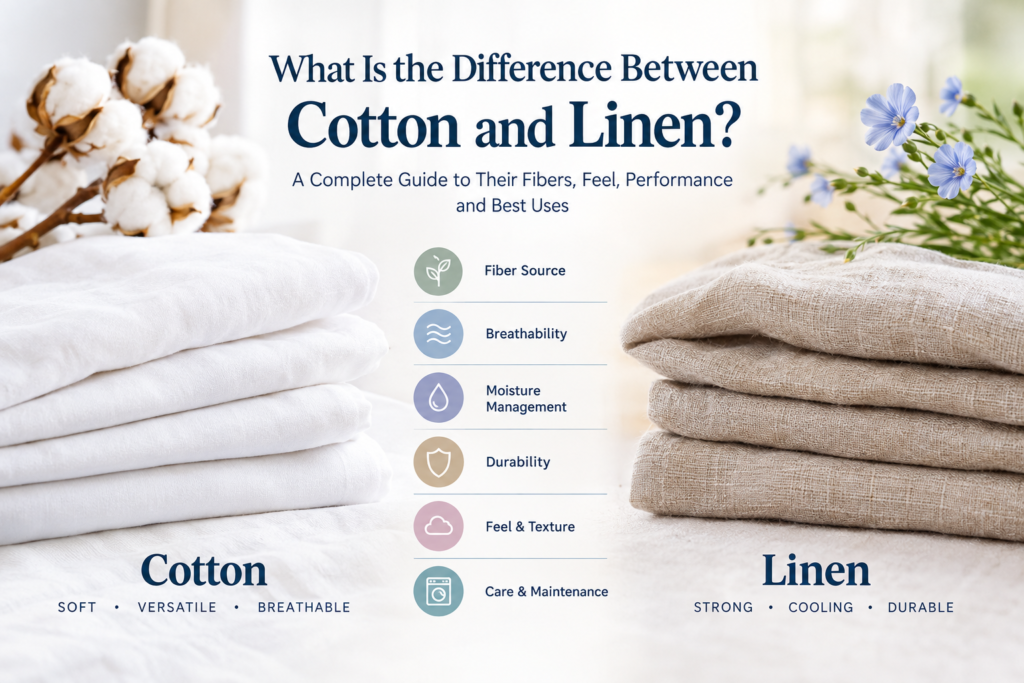
What Is the Difference Between Cotton and Linen? If you are comparing natural fabrics for sheets, bedding, clothing, or other textiles, understanding the difference between cotton and linen can help you choose the right material for your needs. Both are plant-based fibers, but they come from different plants and have different textures, performance characteristics, care requirements, and typical uses. The simplest difference is this: cotton comes from the cotton plant, while linen is made from the fibers of the flax plant. Both can be breathable and moisture-managing, but linen is generally known for stronger breathability and a distinctive crisp, textured feel, while cotton offers a wider range of textures and finishes and is often easier to find at different price points. Cotton vs. Linen at a Glance Feature Cotton Linen Plant source Cotton plant Flax plant Feel Usually soft and smooth Crisp and textured at first Breathability Very good Excellent Moisture management Good Excellent Durability Depends strongly on cotton type and construction Generally very durable Wrinkling Usually moderate More noticeable Softens with washing Yes Yes Temperature regulation Good Excellent Typical appearance Can be smooth, crisp, or silky Naturally relaxed and textured Common bedding use Sheets, duvet covers, pillowcases Sheets, duvet covers, pillowcases These characteristics can vary considerably depending on fiber quality, yarn, weave, finishing, fabric weight, and manufacturing process. What Is Cotton? Cotton is a natural cellulose fiber obtained from the cotton plant. It is one of the most widely used textile fibers and is common in bedding because it can provide softness, breathability, absorbency, and versatility. The final performance of cotton bedding depends on more than the word “cotton” on the label. Fiber length, yarn quality, weave, finishing, and construction all influence how the finished fabric feels and performs. For example, cotton sheets can use different weaves. Percale generally creates a crisp, breathable feel, while sateen creates a smoother surface with a subtle sheen. Long-staple cotton is also commonly associated with softer and more durable fabrics because longer fibers can contribute to smoother and stronger yarns. What Is Linen? Linen is a natural textile made from fibers obtained from the flax plant. Flax fibers are relatively strong, which contributes to linen’s reputation for durability. Linen is particularly valued for airflow and moisture management. The flax and linen performance information published by the Alliance for European Flax-Linen & Hemp explains properties such as air permeability, moisture absorption, and thermoregulation. New linen can feel crisp or somewhat coarse compared with soft cotton. However, linen generally becomes softer with repeated washing and use while retaining its characteristic texture. Difference Between Cotton and Linen for Breathability Breathability is one of the most important differences when comparing cotton and linen bedding. Cotton is naturally breathable, which is one reason it is widely used for sheets. Linen can allow particularly strong airflow and is often selected by people who prefer a cooler, more ventilated sleeping environment. However, “cooling” does not mean that one fabric automatically works better for every person. Fabric weight, weave, room temperature, humidity, mattress construction, duvet insulation, and personal preference also affect sleeping comfort. For hot or humid environments, lightweight breathable bedding can be especially useful. Cotton vs. Linen: Which Is Softer? Cotton usually has the advantage if your first priority is a smooth and familiar soft feel. High-quality cotton can feel soft and comfortable from the beginning, while linen may feel more textured or crisp when new. Linen gradually softens through use and laundering, but it normally retains more of its characteristic natural texture than cotton. This makes the choice partly subjective: Which Is More Durable: Cotton or Linen? Both can be durable, but the result depends heavily on the quality and construction of the fabric. Linen fibers are known for strength and can produce long-lasting textiles when properly manufactured and cared for. Cotton durability varies according to fiber length, yarn, weave, fabric construction, and finishing. This is particularly important for commercial bedding. Hotels and other hospitality businesses need to consider repeated laundering, dimensional stability, fabric construction, replacement cycles, and consistency across bulk orders rather than looking only at the fiber name. For hospitality applications, you can explore commercial hotel bedding from Atlas & Indus Linen as an example of how cotton bedding can be designed around frequent professional laundering and hospitality requirements. Linen vs. Cotton Sheets: Which Should You Choose? There is no universal winner because the right choice depends on what you value. Choose cotton sheets if you want: Cotton is particularly versatile because the same fiber can be manufactured into fabrics with substantially different textures and performance characteristics. Choose linen sheets if you want: Linen can be especially appealing to people who sleep warm or live in hot climates because of its breathability and moisture-management characteristics. Cotton vs. Linen for Hot Sleepers If you frequently feel warm during sleep, fabric breathability should be one of your purchasing considerations. Linen is highly breathable and can promote airflow, while cotton also provides good breathability. The construction of the sheet matters, too. A lightweight, breathable cotton percale, for example, can feel quite different from a heavier cotton sateen. Rather than choosing solely by fiber name, look at: This approach can prevent a common buying mistake: assuming that every cotton sheet or every linen sheet will feel the same. Thread Count: Is Cotton or Linen Better? Thread count should not be compared directly between cotton and linen as if a higher number automatically means better quality. Linen fibers are generally thicker than cotton fibers, so linen commonly has a lower thread count. Sleep Foundation notes that linen sheets often fall into lower thread-count ranges than cotton sheets and that thread count is not generally the only or most useful quality indicator for linen. For linen, GSM can be a more useful measurement to consider alongside fiber quality, construction, and finishing. For cotton, thread count can provide some information, but it should still be considered together with fiber quality and weave rather than used as the sole purchasing criterion. How to Care

what towels do hotels use
Hotel Linen & Hospitality Guides

What Towels Do Hotels Use? 7 Key Hotel Towel Specs

What Towels Do Hotels Use? A Complete Guide to Hotel Towels What towels do hotels use? Most hotels choose towels made from cotton terry because cotton offers a practical combination of absorbency, softness, durability, and suitability for repeated laundering. However, there is no single towel specification used by every hotel. The right choice depends on the property’s positioning, guest expectations, laundry operation, climate, budget, and intended use. Hotel towels are generally selected as part of a wider hospitality linen program. Buyers consider factors such as fiber content, terry construction, GSM, dimensions, edge finishing, absorbency, drying performance, and durability rather than relying on a label such as “hotel quality.” This guide explains what hotels commonly use and what hospitality buyers should look for when choosing towels. What Kind of Towels Do Hotels Use? The most common choice for guest bathrooms is a terry towel, often made primarily or entirely from cotton. Terry fabric uses looped yarns that create a raised surface with a large area for absorbing moisture. Cotton is widely used in towels because of its ability to absorb water and its familiar soft hand feel. Cotton Incorporated notes that terrycloth is favored for towels because cotton has strong water-absorption capability. A typical hotel bathroom may include several towel types: The exact combination varies by hotel and room category. For a hotel, choosing towels is not simply about making them as thick as possible. A towel also needs to be practical for housekeeping, storage, laundering, drying, replacement, and everyday guest use. What Material Are Hotel Towels Made From? 100% Cotton Cotton is one of the most common materials used for hotel towels. A 100% cotton towel can provide a soft, natural hand feel while offering good absorbency. CottonWorks also recommends looking at fiber content, yarn quality, construction, and GSM when assessing textile quality. For hospitality buyers, however, “100% cotton” is only the starting point. Two towels can both be 100% cotton and still perform differently because their yarn, pile, weight, dimensions, finishing, and construction may differ. Combed Cotton Combing removes shorter fibers and some impurities before the cotton is spun into yarn. This can contribute to a smoother and more consistent yarn. Combed cotton is therefore commonly considered when a hotel wants a cleaner hand feel and dependable textile performance. Ring-Spun Cotton Ring spinning is a yarn-spinning method that can produce fine, smooth yarns. Hotels and hospitality suppliers may specify ring-spun cotton when they want a softer hand feel and refined towel construction. However, ring-spun does not automatically mean that a towel is better in every application. The complete specification still matters. Cotton Blends Some hospitality operations may use cotton blends where specific operational characteristics are more important than achieving an entirely cotton construction. A blend can affect drying, strength, weight, feel, and cost. The correct choice depends on where the towel will be used. For example, the requirements for a guest-room bath towel may differ from those for a fitness facility, pool area, or other high-turnover environment. What Is GSM and Why Does It Matter for Hotel Towels? GSM means grams per square meter. It describes the mass of the fabric over a standardized area. In practical terms, GSM helps buyers understand whether a towel is relatively lightweight or heavyweight. Higher GSM generally means a denser, heavier towel, while lower GSM generally indicates a lighter towel. CottonWorks specifically identifies GSM as one of the useful specifications to consider when evaluating towels and notes that higher GSM is associated with greater density and absorbency. However, GSM is not a complete measure of towel quality. A well-constructed medium-weight towel can be more suitable for a hotel than a very heavy towel if the property needs faster drying and efficient laundry processing. Common Hotel Towel GSM Ranges There is no universal hotel GSM standard, but hospitality suppliers commonly offer towels across several weight ranges. Approximate GSM General Characteristics Potential Use 350–450 GSM Lightweight and quicker to dry High-turnover or utility applications 450–550 GSM Balanced weight and practicality General hospitality use 550–650 GSM Fuller and more substantial feel Upscale guest-room applications 650–750 GSM Heavy and plush Premium rooms, suites, or spa environments 750+ GSM Very heavy and dense Specialized luxury or spa applications These ranges should be treated as buying guidelines rather than hotel-industry rules. Current hospitality buying guides show considerable variation in recommended GSM depending on the property’s priorities, with several suppliers emphasizing that GSM alone does not determine quality. Do Luxury Hotels Use Heavier Towels? Some luxury properties choose heavier towels because guests may associate a substantial, plush towel with a premium bathroom experience. But heavier does not automatically mean better. A high-GSM towel uses more material and can require more time and energy to wash and dry. That can matter considerably in a commercial laundry operation. A hotel therefore has to balance: For a luxury spa, a heavier towel may make sense. For a property with very rapid room turnover and limited drying capacity, a somewhat lighter specification may be more practical. Why Do Hotels Often Use Terry Towels? Terry construction is particularly useful for bath towels because its loops create additional surface area. That helps the towel absorb moisture while giving it the familiar textured feel associated with bath towels. CottonWorks also identifies terry construction as an important towel specification and notes that buyers should consider pile type and GSM when assessing towels. The quality of the terry construction matters too. Buyers should look at: A towel should be evaluated as a complete textile rather than by GSM alone. Why Are Hotel Towels Often White? White is a common choice for hotel towels because it creates a consistent, clean visual appearance and simplifies linen management. It also allows housekeeping teams to identify visible staining more easily and helps hotels maintain a consistent look when replacing towels or adding inventory. However, white is not a universal requirement. Hotels, resorts, spas, and boutique properties may use other colors when their interior design or brand identity calls for them. For a

hotel linen quality standards
Hotel Linen & Hospitality Guides

Hotel Linen Quality Standards: What Hotels Should Look For

Hotel Linen Quality Standards: What Hotels Should Look For If you’ve ever compared two hotel bed sheets that both claim to be “premium” and had no real way to tell which one actually was, you’re not alone. Linen suppliers throw around words like luxury, premium, and 5-star grade constantly — but very few buyers are given a clear framework for what those words should actually mean in practice. This guide breaks down the factors that genuinely determine hotel linen quality, why each one matters operationally (not just aesthetically), and how to evaluate a supplier or a sample before you commit to a bulk order. What “Quality” Actually Means for Hotel Linen For a hotel, linen quality isn’t just about how something feels in a showroom. It’s about how it performs across hundreds of guest stays and, just as importantly, hundreds of industrial wash cycles. A sheet that feels wonderful on day one but pills, thins, or loses its shape after a few months of commercial laundering isn’t high quality — it’s just new. So when we talk about hotel linen quality standards, we’re really talking about a combination of things: the raw material, how that material is constructed into fabric, how consistently it’s manufactured, and how well it holds up to the specific stresses of hospitality use — frequent laundering, tucking, folding, and constant handling by housekeeping staff. Why It Matters Beyond the Guest Room Linen quality affects three things at once, and it’s worth separating them because hotels often only think about the first: Keeping all three in mind is what separates a good linen buying decision from one based purely on price or a supplier’s marketing copy. 1. Fiber and Fabric Quality Almost all hotel-grade bedding starts with cotton, because of its balance of softness, breathability, and durability. Within cotton, staple length (the length of the individual fiber) matters: longer, or “long-staple,” fibers can be spun into smoother, stronger yarn with less pilling over time compared to shorter-staple cotton. That’s a real, measurable textile property — not just marketing language. Cotton blends (often cotton with polyester) show up in some hospitality linen too, generally to add wrinkle resistance and reduce shrinkage, sometimes at the cost of some breathability. Neither pure cotton nor a blend is automatically “better” — it depends on your laundry setup, climate, and the guest experience you’re aiming for. 2. Weave and Construction The weave affects how the finished fabric looks, feels, and performs — and it’s a genuine trade-off, not a quality ranking: Neither is objectively superior. The right choice depends on the guest experience your property is going for and how your laundry process handles each fabric type. 3. Thread Count vs. GSM: Which Actually Tells You More This is where a lot of buying decisions go wrong, so it’s worth being direct about it: a higher thread count does not automatically mean better quality. Thread count measures the number of threads woven into one square inch of fabric, and it can be inflated using multi-ply, twisted yarns that count as multiple threads without actually adding real durability or softness. A fabric marketed at 800+ thread count using this technique can perform worse than a well-constructed 300-thread-count single-ply sheet. For most hotel operations, thread counts in the roughly 200–400 range are common and tend to balance comfort, durability, and commercial laundering compatibility well. Beyond that range, you’re often paying for a number rather than a meaningful improvement in feel or performance. A more reliable — and harder to manipulate — measurement is GSM (grams per square meter), which reflects the actual weight and density of the fabric. It’s used more for towels than sheets, but increasingly buyers ask for it on bedding too, precisely because it’s much harder to fake than thread count. The practical takeaway: ask for both figures, but weigh GSM and construction quality more heavily than thread count alone when comparing suppliers. 4. Comfort and Breathability Comfort is subjective, but it’s shaped by objective factors: fiber type, weave, and finishing all play a role in how a fabric feels against skin and how well it regulates temperature. A fabric that traps heat or feels rough after a few washes will show up in guest feedback, even if the guest can’t articulate exactly why the room felt “off.” If possible, test samples the way a guest would actually experience them — after laundering, not straight out of the packaging. Fabric that’s been treated with starch or finishing agents can feel deceptively crisp and heavy when new, and change noticeably after a handful of wash cycles. 5. Durability Under Commercial Laundering This is arguably the single most hospitality-specific quality factor, because hotel linen is laundered far more often and far more aggressively than household linen — usually at higher temperatures and with more mechanical action. Durability here comes down to fiber strength, yarn quality, and construction working together. A fabric can look great in the showroom and still fall apart under repeated industrial washing if the underlying yarn wasn’t strong enough to begin with. Ask suppliers directly how their fabric is expected to perform under your specific laundering conditions — water temperature, detergent type, and wash frequency all affect real-world lifespan, so a number from a different context isn’t automatically transferable to your property. 6. Size, Fit, and Dimensional Consistency Fitted sheets that don’t fit consistently across a batch are a genuine operational headache — they slip off mattresses, look untidy, and slow down housekeeping. Quality linen should be dimensionally consistent from piece to piece and should be shrinkage-controlled, meaning it’s been pre-treated so it doesn’t shrink unpredictably after repeated washing. This is one area where it’s worth asking a supplier directly about their tolerance for size variation across a production run, rather than assuming consistency. 7. Color, Appearance, and Presentation Most hospitality bedding is white, partly for the classic, clean aesthetic, and partly because white makes it easy to visually spot stains during inspection — a practical housekeeping consideration as

hotel bedding selection guide for hospitality businesses
Hotel Linen & Hospitality Guides

Hotel Bedding Selection Guide: How to Choose the Right Linen

Hotel Bedding Selection Guide: How to Choose the Right Linen Choosing hotel bedding is about more than finding sheets that look good. Hospitality bedding needs to provide a comfortable guest experience while also meeting the practical demands of regular use, laundering, storage, and room preparation. From fitted sheets and duvet covers to pillowcases and other bedroom textiles, every part of a hotel bedding setup has a role to play. If you’re comparing options for a hotel, resort, guest accommodation, or other hospitality property, this hotel bedding selection guide can help you understand the key factors to consider before purchasing. What Does Hotel Bedding Include? Hotel bedding can include several different textile products, depending on the property’s room configuration and operating requirements. Common products include: The exact combination depends on the hotel’s bed sizes, room standards, housekeeping procedures, and preferred bedding system. Before purchasing, consider the complete bedding setup rather than evaluating each product separately. Start With the Intended Use The first question to ask is simple: Where and how will the bedding be used? A luxury hotel, resort, guest house, healthcare facility, and residential bedroom can all have different requirements. Hospitality bedding may experience frequent guest use, repeated laundering, handling, folding, storage, and room turnover. Therefore, buyers should consider more than appearance when comparing products. Important considerations can include: Understanding the operating environment makes it easier to choose bedding that fits the property’s actual needs. Consider the Fabric Fabric is one of the most important factors when selecting hotel bedding. Cotton is widely used for bedding because of its familiar feel and breathable characteristics. Other textile constructions may also be appropriate depending on the product and intended application. Rather than choosing a material simply because it sounds premium, consider how the fabric is expected to perform within your hotel’s operation. Important factors can include: Always review the manufacturer’s product specifications before purchasing. Look at Thread Count in Context Thread count is often discussed when comparing hotel sheets and premium bedding, but it should not be the only factor used to evaluate a product. A higher thread count may contribute to a particular fabric feel, but overall bedding quality and suitability can also depend on factors such as the yarn, fabric construction, material, and finishing. For hospitality buyers, a better question is: Does the complete product meet the property’s comfort, performance, care, and operational requirements? Looking at the complete product rather than one specification can support more informed purchasing decisions. Choose Bedding for Guest Comfort Guest comfort should remain central to any hotel bedding decision. Sheets and duvet covers come into direct contact with guests, so their feel and presentation matter. When evaluating products, consider: A comfortable bedding setup can complement the overall presentation of a guest room. Because comfort is subjective, hotels may benefit from evaluating samples before committing to a larger purchase. Consider Commercial Laundering Hotel bedding can go through repeated laundry cycles, making care requirements an important part of product selection. Before purchasing, review the manufacturer’s care instructions and consider whether the product is compatible with the property’s existing laundry process. Hotels should also establish consistent procedures for handling bedding before and after commercial washing. Our guide to hotel linen care after commercial washing provides additional information on inspecting and managing linen following the laundry process. Questions worth considering include: There is no universal washing or drying process that should automatically be applied to every textile. Product-specific instructions should guide care. Choose the Right Fitted Sheet Fitted sheets are designed to fit around the mattress and form an important part of many hotel bedding systems. When selecting a fitted sheet, check the available dimensions and ensure that the product is compatible with the mattresses being used. A good fit can make bed preparation easier and help create a neat appearance. For hotels with multiple room categories, it is also important to keep track of the different mattress and bedding sizes required throughout the property. Select Suitable Duvet Covers or Enclosures The duvet cover or enclosure is another important part of the bedding setup. Hotels should consider its: A well-coordinated duvet cover can contribute to both guest comfort and the visual presentation of the room. Properties looking for a smooth and refined bedding feel may consider high-thread-count duvet enclosures, provided the product specifications meet their operational requirements. Don’t Forget Pillowcases Pillowcases are smaller than sheets and duvet covers, but they remain an important part of the guest bedding experience. They should be compatible with the pillows being used and selected according to the property’s comfort, appearance, care, and operational requirements. Hotels should also include pillowcases when calculating and monitoring their overall linen inventory. Consider Durability and Replacement Hotel bedding needs to be practical for its intended environment. Repeated use and laundering can eventually affect textiles. Depending on the product and operating conditions, signs of wear may include thinning, damaged stitching, discoloration, or other changes in condition. Hotels can monitor bedding condition over time and establish their own replacement procedures. Instead of replacing products according to an arbitrary schedule, businesses can consider actual condition, usage, performance, and operational requirements. Check Sizes Before Ordering Incorrect sizing can create unnecessary problems for housekeeping teams. Before placing an order, confirm: Hotels with different room types should map their bedding requirements by room category. This can make purchasing and inventory management easier while reducing the risk of ordering products that do not match the property’s existing setup. Connect Bedding Selection With Linen Inventory Hotel bedding selection and hotel linen inventory management are closely connected. Purchasing teams need to consider how much bedding the property actually requires, including products currently in use, products in laundry, clean reserve stock, and items that may need replacement. A clear inventory system can help identify shortages and prevent unnecessary purchasing. For larger properties, inventory records can also help management understand which products experience higher usage or require more frequent replacement. Request Samples When Appropriate If you’re considering a new bedding product for a hotel, requesting samples can be

Scroll to Top