Office No. 203, 2nd Floor, Plaza No. 100, Sector Business District North, Phase 8, Bahria Town, Rawalpindi.

Hotel Linen

why are hotel sheets so comfortable
Hotel Linen

Why Are Hotel Sheets So Comfortable? 9 Real Reasons

Why Are Hotel Sheets So Comfortable? The Real Reasons Behind That Luxury Feel Have you ever climbed into a hotel bed and wondered, why are hotel sheets so comfortable? For many guests, hotel sheets feel smoother, crisper, softer, and more inviting than the sheets they use at home. The answer is not usually one secret ingredient or an extremely high thread count. Instead, the comfort of hotel sheets often comes from a combination of fabric quality, weave, sheet construction, laundering practices, and the way the entire bed is prepared. Hotels do not all use the same type of sheet. However, many quality hotel sheets are designed to balance comfort, breathability, durability, and frequent washing. Cotton is widely used in hospitality, while percale and sateen are two popular weave styles that create very different sleeping experiences. In this guide, we explain why hotel sheets can feel so comfortable and what hotels consider when selecting bedding for their guest rooms. Why Are Hotel Sheets So Comfortable? The main reason hotel sheets feel comfortable is that several elements work together. The quality of the fibers, the way the fabric is woven, the finish of the sheets, and regular professional laundering can all influence how bedding feels against the skin. The mattress, pillows, duvet, room temperature, and overall bed preparation can also affect how guests experience the sheets. Many hotels select bedding that offers a balance between softness and durability. Hotel sheets need to feel comfortable for guests while also standing up to repeated laundering and regular use. This is why the most expensive or highest thread-count sheets are not automatically the most comfortable. 1. Hotels Often Choose Quality Cotton Cotton is one of the most common materials used for hotel-style bedding because it can offer breathability, softness, and durability. Higher-quality cotton fibers, including long-staple cotton, are often associated with smoother and more durable fabrics. Longer fibers can be spun into finer, stronger yarns, which may contribute to a smoother fabric surface. Many premium hotel-style sheets use long-staple cotton because it can provide a balance between comfort and long-term performance. However, the type of cotton is only one part of the equation. A comfortable sheet also depends on factors such as: For this reason, simply choosing a sheet because it is labelled as “Egyptian cotton” or “premium cotton” does not automatically guarantee a particular level of comfort. 2. The Weave Makes a Big Difference One important answer to why are hotel sheets so comfortable is the type of weave used to make the fabric. Two common options are percale and sateen. Percale Sheets: Crisp and Cool Percale is a simple over-and-under weave that generally creates a crisp, lightweight, and breathable feel. Many people associate this fresh and cool sensation with traditional hotel bedding. Percale sheets are often preferred by people who enjoy: The exact feel depends on the fiber quality and construction of the fabric, but percale can create the clean and freshly made sensation commonly associated with hotel beds. Sateen Sheets: Smooth and Soft Sateen uses a different weave structure that generally produces a smoother and silkier feel. Sateen sheets may appeal to guests who prefer bedding with: Neither percale nor sateen is automatically better. The best choice depends on the desired guest experience and the requirements of the property. 3. Hotel Sheets Are Designed for Both Comfort and Durability Hotel bedding has a different job than bedding used in a typical home. Sheets in hospitality environments may be washed frequently and used by many different guests throughout their service life. Hotels therefore need bedding that can balance comfort with practical performance. A sheet that feels extremely soft when new but quickly loses its quality may not be suitable for a busy hospitality environment. For this reason, hotels often consider: The goal is usually to provide a pleasant and consistent sleeping experience while maintaining bedding that fits the operational needs of the property. 4. Thread Count Is Not the Only Reason Hotel Sheets Feel Good One of the biggest misconceptions about luxury bedding is that a higher thread count always means better sheets. Thread count measures the number of threads woven into a square inch of fabric, but it does not tell you everything about sheet quality. The fiber quality, yarn construction, and weave can be equally important. Quality hotel-style sheets are commonly available across a range of thread counts. Sleep Foundation notes that cotton percale sheets used in hotels often fall within approximately the 250 to 600 thread-count range, while cotton sateen sheets are also commonly found in moderate ranges. Extremely high thread-count claims should not automatically be treated as proof of better quality. A well-made sheet with quality fibers and an appropriate weave can feel more comfortable than a poorly constructed sheet with a much higher advertised thread count. 5. Professional Laundering Can Change How Sheets Feel Another reason hotel sheets can feel especially comfortable is the way they are cleaned and maintained. Hotels often use commercial laundry processes designed to clean, rinse, dry, and finish large volumes of linen consistently. The exact laundering process varies between properties and laundry providers. Water temperature, detergents, drying methods, finishing equipment, and fabric type can all affect the final feel of the sheets. Freshly laundered and properly finished sheets can feel: However, professional laundering alone cannot turn poor-quality fabric into premium bedding. The quality of the original fabric and the way it is cared for both matter. 6. White Sheets Can Make a Bed Feel Fresher Most hotels use white bedding, and this choice can influence how guests perceive comfort and cleanliness. White sheets create a simple, uniform appearance and make it easier to identify visible stains or discoloration. The psychological effect of a freshly prepared white bed can also contribute to the overall hotel experience. Guests may associate crisp white sheets with cleanliness, freshness, and relaxation. This visual impression works alongside the physical characteristics of the fabric. In other words, part of the hotel-bed experience is what you see before you even
hotel linen lifecycle cost
Hotel Linen

Hotel Linen Lifecycle Cost: How to Measure Real Cost

Hotel Linen Lifecycle Cost: How to Measure the Real Cost of Hotel Linen Buying hotel linen based only on the lowest unit price can make procurement appear simple, but the purchase invoice is only one part of the overall cost. Sheets, pillowcases, duvet covers, towels, bath mats, and other hospitality textiles continue to create costs throughout their useful life. Every item must be stored, laundered, inspected, handled, and eventually replaced. The way linen is selected and managed can therefore influence both purchasing budgets and day-to-day hotel operations. This is where hotel linen lifecycle cost becomes useful. Instead of asking only, “How much does this sheet or towel cost?”, hotel procurement teams can ask a broader question: How much does this linen cost to purchase, operate, maintain, and replace over its useful life? A lifecycle approach provides a more complete basis for comparing linen products and suppliers. It can help hotels evaluate durability, laundry requirements, replacement rates, supplier reliability, and cost per useful service period rather than relying on purchase price alone. What Is Hotel Linen Lifecycle Cost? Hotel linen lifecycle cost is the total cost associated with a linen item or linen program throughout its useful operating life. Depending on the hotel’s operation, this can include: The exact cost structure varies between properties. A hotel with an outsourced laundry service will calculate its costs differently from a property operating an on-site laundry. Likewise, a small boutique hotel and a large resort can have very different linen usage patterns. That is why lifecycle costing should be based on actual property data wherever possible. Current hospitality procurement guidance increasingly recommends evaluating linen beyond the initial purchase price and considering replacement and laundering costs as part of the broader ownership picture. Why Purchase Price Alone Can Be Misleading Suppose two suppliers offer similar hotel sheets. Supplier A has a lower price per piece. Supplier B has a higher price per piece but provides a product that better matches the hotel’s intended commercial use and laundering process. If both products perform differently over time, comparing only their purchase prices does not provide enough information to determine which option represents better value. The higher-priced product is not automatically better, either. A premium price does not guarantee longer service life, lower laundry costs, or a better total outcome. The correct approach is to evaluate the product against the hotel’s actual requirements. This is the central idea behind total cost of ownership for hotel linen. The Main Components of Hotel Linen Lifecycle Cost A useful lifecycle analysis should consider several cost categories rather than focusing on one number. 1. Initial Linen Purchase Cost The first cost is the most obvious: the amount paid to purchase the linen. For a hotel, this can include: When comparing suppliers, make sure the quoted prices are being compared on a reasonably equivalent basis. A lower quote for a different specification does not necessarily represent a lower cost. For example, differences in dimensions, fabric composition, construction, finishing, or weight may affect performance and suitability. 2. Laundry and Processing Cost Hotel linen can pass through commercial or high-frequency laundering many times during its useful life. Processing may involve: For hotels with in-house laundry, these activities consume resources such as water, energy, chemicals, equipment capacity, and labor. For outsourced laundry, many of these expenses are reflected in the service price charged by the laundry provider. The important point is that laundry cost should be considered when comparing linen products intended for frequent commercial use. Current industry analysis of hotel linen lifecycle economics similarly emphasizes laundry and replacement as important parts of the overall cost picture. 3. Linen Replacement Cost Eventually, every hotel linen item reaches a point where it is no longer suitable for its intended use. The reason may include: Hotels should avoid assuming that every item has a fixed universal lifespan. Actual service life depends on the product, laundering process, usage level, handling practices, and the hotel’s quality standards. Instead of asking how many washes a particular product “always” survives, procurement teams should track their own results where practical. This creates a much more reliable basis for future purchasing decisions. 4. Linen Loss and Shrinkage Not every linen item disappears because it has reached the end of its useful life. Hotels can also experience inventory losses through misplacement, damage, unauthorized removal, or other operational causes. Shrinkage is another consideration. Textile dimensions can change during laundering depending on fiber content, construction, finishing, and processing conditions. For hotels purchasing fitted sheets, duvet covers, or other size-sensitive products, maintaining appropriate dimensional performance is important. The key is to measure actual losses and dimensional changes rather than assigning an unsupported universal percentage. 5. Storage and Handling Linen also occupies physical space. Hotels need suitable areas for: Excess inventory can increase storage requirements and tie up purchasing capital. Insufficient inventory, on the other hand, can create operational pressure and increase the risk of emergency purchasing. This is why lifecycle planning should work together with hotel linen inventory management and reorder planning. How to Calculate Hotel Linen Lifecycle Cost There is no single formula that fits every hotel, but a practical starting model is: Lifecycle Cost = Acquisition Cost + Processing Cost + Handling Cost + Replacement Cost + Loss-Related Cost For a more useful comparison, the result can then be evaluated against the amount of service obtained from the product. For example, a hotel could calculate: Cost per usable cycle = Total relevant lifecycle cost ÷ Number of usable cycles Or, where the hotel’s data supports it: Cost per occupied room use = Relevant lifecycle cost ÷ Number of occupied-room uses These are management calculations rather than universal industry standards. The purpose is to compare products using the hotel’s own operating conditions. A Simple Example Imagine a hotel is comparing two bath towel options. The first towel costs $8 per unit. The second costs $11 per unit. At first glance, the $8 towel appears cheaper. But suppose the hotel records the following over a defined evaluation

hotel linen replacement schedule
Hotel Linen

Hotel Linen Replacement Schedule: Sheets & Towels

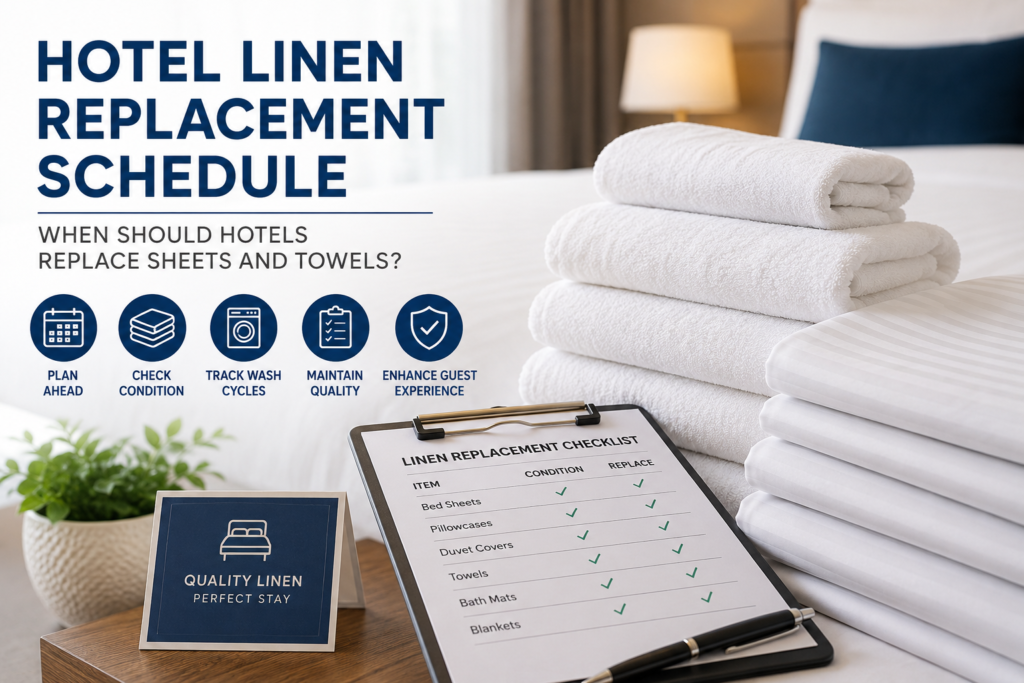
Hotel Linen Replacement Schedule: When Should Hotels Replace Sheets and Towels? Introduction A well-planned hotel linen replacement schedule helps hotels maintain consistent room presentation, guest comfort, housekeeping efficiency, and predictable purchasing costs. Sheets, pillowcases, towels, duvet covers, blankets, and other textiles experience different levels of use, so replacing everything on the same calendar date is rarely the most practical approach. There is also no universal replacement date that applies to every hotel. Linen lifespan depends on factors such as occupancy, laundry frequency, fabric construction, laundering conditions, inventory levels, and the standard expected by the property. For that reason, hotels can benefit from combining a planned replacement schedule with regular condition inspections. This approach helps housekeeping and procurement teams identify worn textiles before they become a guest-facing problem while avoiding unnecessary replacement of items that are still performing well. This guide explains how to build a practical hotel linen replacement schedule and the signs that indicate when different types of premium hotel bed sheets and other linen may need to leave active service. What Is a Hotel Linen Replacement Schedule? A hotel linen replacement schedule is a planned system for monitoring and replacing textiles used throughout a property. It can cover: The purpose is not simply to replace linen after a fixed number of months. Instead, the schedule gives housekeeping and procurement teams a framework for tracking textile condition, usage, laundry exposure, stock levels, and replacement requirements. A good program combines planned reviews with condition-based decisions. Why Hotels Need a Linen Replacement Schedule Without a replacement plan, linen purchasing can become reactive. A housekeeping team may discover that too many sheets are worn at the same time, or a hotel may need to place an urgent order after several towels become unusable. Planned replacement helps reduce these situations. 1. Maintain Consistent Guest Presentation Guests notice the condition of sheets and towels. Thin fabric, frayed edges, persistent discoloration, excessive pilling, or poor absorbency can affect the perceived quality of a room. A regular inspection process allows hotels to remove visibly worn items before they affect the guest experience. 2. Control Linen Purchasing Costs Replacing all linen at once can create an unnecessary financial burden. A phased replacement program allows procurement teams to forecast upcoming requirements and plan purchases around actual operational needs. 3. Support Housekeeping Efficiency Worn linen can require additional handling, sorting, or reprocessing. If textiles repeatedly fail inspection, housekeeping teams spend more time separating unsuitable pieces from usable stock. 4. Protect Inventory Levels Replacement planning should be connected to the hotel’s linen inventory. When damaged or retired items are removed, replacement quantities should be reviewed so the property continues to maintain adequate operating stock. 5. Improve Long-Term Textile Management A replacement schedule creates useful historical information. Hotels can compare textile performance across suppliers, fabric constructions, product categories, and laundry processes. This can make future purchasing decisions more evidence-based. How Often Should Hotels Replace Linen? There is no single replacement interval that applies to every hotel. Some industry guidance uses calendar periods or approximate wash-cycle counts as planning benchmarks, while other hospitality operators emphasize condition and operational performance. Industry research on hospitality textile life and replacement commonly places sheets and towels within broad replacement ranges rather than treating a single date as mandatory. For this reason, hotels should treat any timeline as a planning reference rather than an automatic retirement date. For example, a high-occupancy property with frequent commercial laundering may experience faster textile wear than a lower-occupancy property using the same products. Laundry chemistry, drying temperature, mechanical action, water quality, and textile construction can also influence useful life. The better question is not simply: “How many months old is this linen?” It is: “Does this linen still meet the hotel’s required standard for appearance, performance, comfort, and operational use?” Hotel Linen Replacement Schedule by Category Different textile categories experience different levels of wear. A practical schedule should therefore separate them rather than applying one replacement date to everything. Bed Sheets Bed sheets are exposed to frequent guest use and repeated commercial laundering. They should be inspected for thinning, pilling, fraying, seam damage, persistent discoloration, and changes in overall appearance. Some hospitality references use approximately 12–24 months or around 100–150 commercial wash cycles as a planning range for sheets, but actual performance can vary substantially by property and laundering conditions. Instead of automatically retiring every sheet after a particular date, hotels should track: A sheet that remains in excellent condition may continue in service, while a heavily worn sheet may need to be removed earlier. Properties sourcing durable, shrinkage-controlled fitted sheets built for frequent commercial laundering often see more predictable wear patterns from the outset. Pillowcases Pillowcases receive frequent contact and laundering and can show wear before other bedding components. Inspect them for: Because pillowcases are relatively small and inexpensive compared with larger bedding pieces, hotels can often manage the replacement of their hotel pillowcases through regular inspections and smaller rolling purchases. Duvet Covers Duvet covers should be evaluated for fabric thinning, seam damage, broken closures, staining, and excessive wear. Their useful life depends heavily on how frequently they are changed and laundered. A property with high turnover may put considerably more laundry stress on hotel duvet covers than a lower-occupancy property. Towels Hotel towels often experience particularly intensive use because they are used frequently and typically washed after guest use. Common signs that a towel should be considered for retirement include: Industry guidance varies on towel replacement timing, with some sources suggesting roughly 12–18 months while others give wider ranges depending on usage and laundering. This variation reinforces the importance of condition-based inspection rather than relying exclusively on the calendar. Selecting well-constructed hotel bath towels built for absorbency and repeated commercial washing can also extend useful service life. Bath Mats Bath mats should be checked regularly because they experience repeated moisture exposure and frequent laundering. Inspect for: A hotel bath mat that no longer performs properly should be removed from guest use even if it has not reached the

Marrakech hotel linen suppliers
Hotel Linen

Marrakech Hotel Linen Suppliers: What to Prepare for 2030

Marrakech is entering an important period of hotel development. New international brands and independent hospitality projects are being announced around the city, while Morocco has set a national target of adding approximately 60,000 hotel beds by 2030. The country’s tourism minister has described the 2030 FIFA World Cup as an accelerator for wider tourism and infrastructure investment rather than an end in itself. For hotel linen suppliers, the significance is straightforward: every new property eventually needs a reliable supply of bed linen, bath linen and other hospitality textiles—not only for its opening inventory, but also for ongoing replacement and replenishment. The opportunity, however, is not simply about producing more sheets and towels. For hotel developers and procurement teams, the more important questions are when linen should be specified, how products should be tested, what quantities should be planned, how textiles will perform under commercial laundering, and whether a supplier can reproduce the same specification after the hotel opens. That makes the 2030 hotel pipeline relevant to both sides of the procurement relationship. Important: Hotel projects and opening dates can change. The developments discussed below are described according to information published by the relevant hotel companies, operators or other reputable sources available at the time of writing. Marrakech’s Hotel Pipeline Is Expanding Marrakech already has a mature hospitality market, but the current development pipeline includes projects from several international hotel groups and luxury operators. That matters because different hotel concepts can create different textile requirements. A compact lifestyle hotel, a luxury resort, a countryside retreat and a property with villas and branded residences will not necessarily use the same room, bathroom, spa or pool linen specifications. Several announced or newly operating projects illustrate the range of development taking place around Marrakech. Kimpton Marrakech IHG Hotels & Resorts announced the first Kimpton hotel in Morocco in December 2025. Kimpton Marrakech is planned as a 67-key luxury lifestyle hotel, with IHG announcing a Q4 2026 opening target. For procurement teams, a project of this type highlights the importance of having room and bathroom textiles specified well before opening. Lifestyle positioning can also mean that standard hotel linen specifications need to be coordinated with interior design, brand standards and the property’s wider guest experience. Virgin Limited Edition Marrakech Virgin Limited Edition has announced a 37-bedroom luxury retreat near Marrakech, located on a private agricultural estate. The company says the first 22 hotel keys are targeted for Q1 2027, with the remaining 15 planned for Q1 2028; it also notes that project timelines can change. This is an example of why suppliers should not think only in terms of conventional city hotels. A smaller luxury property can have highly specific requirements for: The volume may be smaller than a large hotel, but the specification can be more specialized. Amerruk, Marrakech, Autograph Collection Marriott’s current website lists Amerruk, Marrakech, Autograph Collection as a new property. The hotel is presented as a countryside retreat on a 7-hectare estate, with rooms, suites and villas, a hammam spa, pools and dining facilities. The property’s current presentation also illustrates an important point for textile suppliers: hospitality development is not limited to standard guestroom inventories. Properties with villas, spas, outdoor facilities and multiple guest experiences may require several coordinated textile categories. Eden Palm Marrakech, Curio Collection by Hilton Hilton has announced Eden Palm Marrakech, Curio Collection by Hilton, a 62-room-and-suite property scheduled to open in 2029. Projects scheduled for the later part of the decade are particularly relevant when thinking about procurement planning for 2030. The further ahead a project is from opening, the more important it becomes to distinguish between: Those are different stages and should not be treated as the same procurement event. Delano Hotel & Residences Marrakech Ennismore’s announced Delano Hotel & Residences Marrakech is planned to include 130 guestrooms, including suites and private villas, alongside approximately 80 branded residences. Ennismore says the residences are scheduled to launch for sale in late 2026 and the hotel is planned to open in 2030. This is particularly relevant to the linen discussion because the project combines hotel accommodation, villas, wellness facilities and event spaces. It demonstrates why future hotel linen procurement in Marrakech cannot be reduced to a simple calculation of “one set of sheets per room.” What More Hotel Rooms Mean for Linen Suppliers The connection between hotel development and textile procurement is easy to overlook. A new hotel room needs more than a mattress and decorative bedding. Depending on the property’s concept and specification, a guestroom may require: Additional departments may require their own textile inventory, including restaurants, banqueting, wellness and housekeeping operations. The result is a procurement chain that begins long before the first guest checks in. Hotel development → design specification → textile specification → samples → approval → production → inspection → delivery → room setup → laundry rotation → replenishment A supplier that understands this entire process can provide considerably more value than one that simply quotes a unit price. Hotel Linen Procurement Should Start With the Specification One of the most important decisions for a new hotel is agreeing exactly what is being purchased. The term “hotel linen” covers a large range of products, and two products that look similar in a catalogue can perform differently once they enter a commercial laundry environment. A procurement specification may need to address: Fabric composition The buyer may specify natural fibres, blended constructions or another material depending on the property’s positioning and operating requirements. The important point is that the specification should be agreed before bulk production. Dimensions Hotels need consistent dimensions across their room inventory. Bed sizes, mattress depths, duvet dimensions and pillow sizes should be confirmed against the property’s actual room schedule rather than assumed from a generic hotel specification. Fabric construction Construction affects characteristics such as feel, appearance, strength and laundering performance. The right choice depends on the hotel’s operating requirements and guest experience—not simply on a product being described as “luxury.” GSM and weight GSM can be relevant for towels and

hotel linen inventory management
Hotel Linen

Hotel Linen Inventory Management: A Practical Guide

Hotel Linen Inventory Management: A Practical Guide for Hospitality Teams Managing hotel linen effectively is an important part of running a well-organized hospitality operation. Bed sheets, pillowcases, duvet covers, towels, bath mats, and other textiles move through guest rooms, housekeeping areas, laundry facilities, and storage rooms every day. Without a clear system, hotels can experience unnecessary shortages, excess stock, damaged linen remaining in circulation, or difficulty understanding when products need to be replaced. Hotel linen inventory management provides a practical framework for tracking, organizing, inspecting, and replenishing these essential textiles. The right system will vary from one property to another, but the basic principles are useful for hotels, resorts, serviced apartments, guest houses, and other accommodation businesses. What Is Hotel Linen Inventory Management? Hotel linen inventory management is the process of monitoring and organizing the textile products a property needs for its daily operations. It can include: Inventory management is not simply counting how many pieces are stored in a linen room. It also involves understanding where products are being used, which items are in laundry, which pieces are available for use, and which products need repair or replacement. A well-organized system gives housekeeping and management teams a clearer picture of the hotel’s actual linen requirements. Why Hotel Linen Inventory Management Matters Hotels need enough linen to support occupied rooms while other textiles are being washed, dried, inspected, or stored. If inventory is too low, housekeeping teams may struggle during busy periods. If the property holds significantly more stock than it needs, storage space and purchasing budgets may be used inefficiently. Effective inventory management can help hotels: The objective is not to maintain a particular inventory number simply because another hotel uses it. Each property should determine its requirements based on its own operation. How to Calculate Hotel Linen Requirements There is no universal number of linen pieces that every hotel needs. The appropriate inventory depends on several factors. Number of Guest Rooms A larger property will generally require more linen than a smaller one. However, room count alone does not determine the correct inventory level. Occupancy Patterns A hotel with consistently high occupancy may need different stock levels from a property with significant seasonal changes. Understanding expected occupancy patterns can help managers plan their linen requirements more realistically. Laundry Turnaround Time The time required to collect, wash, dry, inspect, and return linen to storage can affect how much usable stock a hotel needs. Longer turnaround periods may require additional reserve inventory so housekeeping operations can continue without interruption. Room Configuration Different room types may require different combinations of sheets, pillowcases, duvet covers, towels, and other textiles. A hotel should therefore calculate inventory according to its actual room configurations. Replacement and Loss Linen can become unsuitable for use because of wear, damage, permanent staining, loss, or other operational factors. Replacement requirements should be considered when planning inventory rather than treating them as unexpected events. What Is a Linen Par Level? A linen par level is a target amount of linen that a hotel aims to maintain for a particular operation. The appropriate level depends on the property’s room count, occupancy, laundry process, storage capacity, and operating procedures. For example, a hotel may establish separate target levels for sheets, pillowcases, bath towels, and other textile categories. The important point is that par levels should reflect the hotel’s actual requirements rather than being copied from another property without evaluation. How to Organize a Hotel Linen Inventory A simple organization system can make inventory easier to monitor. Hotels can separate linen by: For example, king-size sheets can have a dedicated storage location separate from queen-size sheets. Similarly, bath towels and hand towels can be stored separately so housekeeping teams can locate the correct products efficiently. Clear labels can make the system easier to understand, particularly when multiple employees work in the linen room. Keep Clean and Used Linen Separate One of the basic principles of linen management is keeping clean and used textiles appropriately separated. Used linen should follow the hotel’s established collection and laundry process, while clean linen should be stored in a suitable environment that protects it from unnecessary contamination, moisture, and dust. The exact procedures will depend on the hotel’s facilities and operational policies. Inspect Linen Before Returning It to Stock Counting linen is only part of inventory control. Hotels should also monitor condition. After laundering, staff can check for: Items that no longer meet the property’s requirements can be separated for appropriate action. This prevents damaged or unsuitable textiles from being counted as fully usable inventory. Track Linen Loss and Damage Linen inventory can change for reasons other than normal wear. Products may become damaged, permanently stained, misplaced, or otherwise unavailable. Recording these events can help management identify patterns. For example, if a particular product repeatedly needs replacement, the hotel can investigate whether the issue relates to product suitability, laundering, handling, storage, or another operational factor. The purpose of tracking is not simply to record losses. It is to understand why they occur. Hotel Towel Inventory Management Towels deserve specific attention because their performance requirements differ from those of bed linen. Hotels may manage separate stock levels for: Inventory teams should monitor both quantity and condition. A towel that is physically present but no longer suitable for guest use should not be treated as fully usable inventory. Hotels can therefore combine quantity checks with condition inspections. How Often Should Hotel Linen Inventory Be Checked? There is no single checking schedule that is appropriate for every property. The frequency can depend on: A property with a high volume of daily linen movement may require more frequent monitoring than a smaller operation. The important objective is to identify shortages, losses, and unusual changes before they disrupt housekeeping operations. Create a Simple Linen Inventory Record A basic record can contain information such as: Linen type Size Usable stock In laundry Damaged Replacement needed Bed sheets King — — — — Bed sheets Queen — — — — Pillowcases Standard — —

hotel linen care after commercial washing
Hotel Linen

Hotel Linen Care After Commercial Washing: Complete Guide

Hotel Linen Care After Commercial Washing: A Practical Guide Hotel linen goes through a demanding cycle of washing, drying, handling, storage, and repeated use. For hotels, resorts, serviced apartments, and other hospitality businesses, maintaining linen quality is not simply about keeping sheets and towels clean. Proper care after commercial washing can also help protect fabric condition, maintain presentation, and identify worn items before they become a larger operational problem. Hotel linen care after commercial washing starts as soon as the washing cycle is complete. How linen is dried, inspected, handled, folded, stored, and rotated can all affect its ongoing condition. This guide explains practical ways hospitality teams can care for hotel bed linen and towels after commercial laundering while following the care requirements of the specific textile. Why Hotel Linen Needs Proper Care After Commercial Washing Commercial laundry processes are designed to handle large volumes of hospitality textiles. Hotel sheets, pillowcases, duvet covers, towels, and other linen may be washed frequently and exposed to mechanical action, detergents, heat, and drying processes. The exact effect depends on the fabric, construction, laundering process, and manufacturer’s care instructions. That is why there is no single washing or drying method that is appropriate for every type of hotel linen. Post-wash handling is another important part of the process. Linen that has been properly washed can still develop problems if it is stored while damp, handled carelessly, exposed unnecessarily to heat, or returned to service without inspection. A consistent post-wash routine helps housekeeping and laundry teams identify issues early and maintain better control over linen inventory. How to Handle Hotel Linen Immediately After Washing The period immediately after washing is an important part of hotel linen maintenance. Remove Linen From the Laundry Process Promptly Clean textiles should be handled according to the laundry facility’s established procedures rather than being left in an unsuitable environment for longer than necessary. Prompt handling can help the team move clean linen efficiently toward drying, finishing, inspection, and storage. Separate Linen by Type Hotel laundry commonly includes several different textile categories, such as: Separating items by type makes inspection, folding, storage, and inventory management easier. It also helps teams apply the appropriate care requirements to different textile products. Inspect Before Folding and Storage A quick inspection can identify: Items that do not meet the hotel’s cleanliness or quality standards should be handled according to the property’s laundry and replacement procedures. Proper Drying Practices for Hotel Linen Drying is a major part of post-wash linen care. The correct drying process depends on the textile and its manufacturer’s instructions. Hotel teams should avoid assuming that the same heat level or drying duration is suitable for every product. Avoid Unnecessary Over-Drying Excessive heat or prolonged drying can place additional stress on some textile materials. The goal should be to achieve the required dryness while following the care instructions supplied for the particular linen. This is especially important when a hotel uses several different fabric constructions or blends. Follow Manufacturer Care Instructions Care labels and supplier specifications should take priority over generic laundry advice. When purchasing hotel linen, hospitality buyers should keep the recommended washing and drying requirements available for laundry and housekeeping teams. This creates a more consistent process and reduces the risk of applying unsuitable treatment to a particular textile. Make Sure Linen Is Fully Dry Before Storage Clean linen should be properly dried before it is placed into storage. Storing damp textiles can create avoidable moisture-related problems and may compromise the condition of otherwise clean linen. For this reason, dryness should be one of the checks completed before clean stock enters the linen room. How to Inspect Hotel Linen After Commercial Washing Inspection should be a routine part of hotel linen management rather than something done only when a guest complaint occurs. A simple inspection system can help housekeeping teams identify recurring laundry or textile problems. Check Cleanliness Look for remaining visible soil, stains, or other signs that the item requires additional processing according to the property’s procedures. Check Fabric Condition Look for signs of excessive wear, thinning, holes, or other physical damage. A single damaged item does not necessarily indicate a problem with the entire laundry process. However, repeated damage across similar products may justify reviewing the laundering and handling procedures. Check Seams and Hems Seams and hems can experience repeated stress during use and laundering. Inspect for: Early identification allows the hotel to remove unsuitable pieces from guest use before the condition becomes more noticeable. Check Towels for Condition and Absorbency Towels have different performance requirements from bed linen. In addition to checking cleanliness and physical condition, housekeeping teams can monitor whether towels continue to provide the level of absorbency expected for their intended use. If a recurring reduction in towel performance is noticed, the hotel can investigate the textile, laundering process, drying process, and product specifications rather than assuming one cause. How to Store Hotel Linen After Washing Proper storage protects the work already completed during the laundry process. Store Only Fully Dry Linen Before clean linen enters storage, confirm that it is properly dry. This simple step should be part of the property’s normal linen-room procedure. Keep Clean Linen Protected Clean textiles should be stored in an environment that protects them from unnecessary exposure to dust, moisture, and other sources of contamination. The exact storage arrangement will depend on the hotel’s facilities and operating procedures. Organize Linen by Type and Size A well-organized linen room makes it easier for housekeeping staff to find the correct items and maintain inventory. For example, separate storage areas can be used for: Clear organization can also make stock checks more efficient. Rotate Usable Linen Hotels can use an appropriate stock rotation system so that usable linen is distributed consistently rather than allowing some pieces to remain unused for long periods. A rotation process should work alongside the hotel’s existing inventory and housekeeping procedures. How to Extend the Useful Life of Hotel Linen There is no universal lifespan that applies to

hotel linen checklist for Moroccan riads
Hotel Linen

Hotel Linen Checklist for Moroccan Riads: Complete Guide

Hotel Linen Checklist for Moroccan Riads: A Practical Guide for Owners & Managers Hotel linen checklist for Moroccan riads planning, purchasing, and daily housekeeping can make a significant difference to guest comfort, room presentation, laundry efficiency, and operating costs. A riad is not simply a smaller hotel. These traditional Moroccan properties are typically organized around an interior patio or garden and are valued for their distinctive atmosphere, hospitality, and sense of place. That means linen needs to do two jobs at once: it must perform reliably in a hospitality environment while also supporting the clean, comfortable, and refined experience guests expect. A practical linen system should cover bed linen, bathroom towels, pool or hammam towels where applicable, bath mats, robes, decorative textiles, laundry stock, replacement items, and housekeeping controls. This guide provides a practical hotel linen checklist for Moroccan riads, whether you operate a small guesthouse in Marrakech, a traditional property in Fes, a boutique riad in Essaouira, or a larger luxury accommodation. Why Do Moroccan Riads Need a Dedicated Linen Checklist? Linen is one of the most frequently handled parts of a guest room. Sheets are removed, washed, dried, folded, inspected, stored, transported, and placed on beds repeatedly. Towels experience similar cycles, often with additional exposure to water, cosmetics, pool use, hammam services, and intensive laundry. Without a defined checklist, it is easy for a riad to experience problems such as: A checklist turns linen management into a repeatable housekeeping process rather than something staff have to remember from day to day. Hotel Linen Checklist for Moroccan Riads Before purchasing or reviewing your current inventory, divide your linen into clear categories. 1. Bed Linen Checklist Every guest bed should have the correct linen for its size and configuration. Check your inventory for: The exact combination depends on the riad’s bed configuration. For example, one room might use a 160 cm double bed while another uses two single mattresses. Some riads also have family rooms or suites with additional sleeping arrangements. Real Moroccan riads show how varied these configurations can be. For example, Riad Explore lists queen-size beds, twin configurations, cotton bed linen, thermal blankets, and non-feather pillows among its room facilities. The important point is to inventory linen according to actual bed sizes, not simply count “one set per room.” 2. Pillow Linen Checklist Pillows have a direct relationship with guest comfort, so pillow protection should be part of the linen plan. Your checklist should include: Keep pillowcases grouped by size so housekeeping staff can quickly select the correct items. If your riad uses different pillow sizes across rooms, label storage shelves clearly. 3. Bathroom Linen Checklist Bathroom linen is especially important because guests notice towel quality quickly. A basic bathroom inventory may include: Some Moroccan riads provide a combination of bath towels, hand towels, pool towels, bath mats, and bathrobes as part of the guest experience. Your exact requirements should depend on the facilities and service level of your property. A riad with a swimming pool needs a different towel inventory from a small property without one. 4. Pool and Hammam Linen Checklist If your riad offers a pool, hammam, or spa-style service, create a separate inventory category rather than mixing those textiles with standard bathroom linen. Consider: Separating these items makes stock control easier and helps prevent staff from accidentally using specialty towels for standard room turnover. How Many Linen Sets Does a Riad Need? There is no single number that works for every Moroccan riad. Your required stock depends on: Instead of relying on a generic number, calculate your linen requirement based on your actual operation. For example, if a riad has 10 rooms, six of which contain double beds and four of which contain twin configurations, the inventory should be calculated according to those individual bed types. Then add enough replacement stock to cover laundry cycles, room turnover, unexpected stains or damage, and periods when occupancy is high. The objective is simple: housekeeping should never have to delay a room because clean linen is unavailable. Choosing Bed Linen for a Moroccan Riad The best bed linen is not necessarily the heaviest or most expensive option. For a riad, consider five practical characteristics: Comfort Guests should experience a clean, comfortable sleeping surface. Softness and breathability can be particularly important in warm climates. Durability Commercial linen needs to withstand repeated laundering. A fabric that feels excellent after the first few washes but deteriorates rapidly may cost more over its useful life. Easy Care Consider how easily the fabric can be washed, dried, ironed, folded, and stored. A beautiful fabric that creates excessive laundry problems may not be practical for a busy property. Appearance Crisp, clean bedding contributes to the visual presentation of the room. White and neutral linen can create a clean hospitality appearance, while carefully selected decorative textiles can provide Moroccan character. Consistency Once you choose a linen specification, try to maintain consistency across rooms where possible. Guests should receive the same basic quality whether they stay in one room or another. Current hotel-linen procurement guidance commonly evaluates bed linen using factors such as fibre, weave, thread count, durability, and laundering requirements rather than relying on one specification alone. Choosing Towels for a Moroccan Riad Towels need to balance softness, absorbency, drying time, durability, and laundry cost. When comparing towels, look at: A heavier towel can feel luxurious, but it may also take longer to dry and require more laundry resources. For that reason, don’t select towels based on GSM alone. One current Moroccan hotel-linen supplier guide notes that professional buyers should consider both fabric specifications and practical laundry requirements when selecting hospitality linen. For a riad, the right towel is the one that gives guests a good experience without creating unnecessary operational problems. Hotel Linen Checklist for Guest Bathrooms Use this quick room-by-room check before every guest arrival: A visual inspection should happen before linen reaches the guest room, not after the guest has already noticed a problem. Hotel Linen Checklist for Guest Bedrooms

Scroll to Top